<?xml version="1.0" encoding="utf-8"?><feed xmlns="http://www.w3.org/2005/Atom" ><generator uri="https://jekyllrb.com/" version="4.4.1">Jekyll</generator><link href="/feed.xml" rel="self" type="application/atom+xml" /><link href="/" rel="alternate" type="text/html" /><updated>2026-08-16T04:57:12+00:00</updated><id>/feed.xml</id><title type="html">Geneve Reyes</title><subtitle>Powered by Jekyll and GitHub Pages</subtitle><author><name>Paul Le</name></author><entry><title type="html">Second Place, Solo</title><link href="/second-place-solo" rel="alternate" type="text/html" title="Second Place, Solo" /><published>2025-10-19T00:00:00+00:00</published><updated>2025-10-19T00:00:00+00:00</updated><id>/second-place-solo</id><content type="html" xml:base="/second-place-solo"><![CDATA[<p>I entered an internal hackathon last summer as a one-person team. 275 people, 35 solutions, most groups running two to five deep.</p>

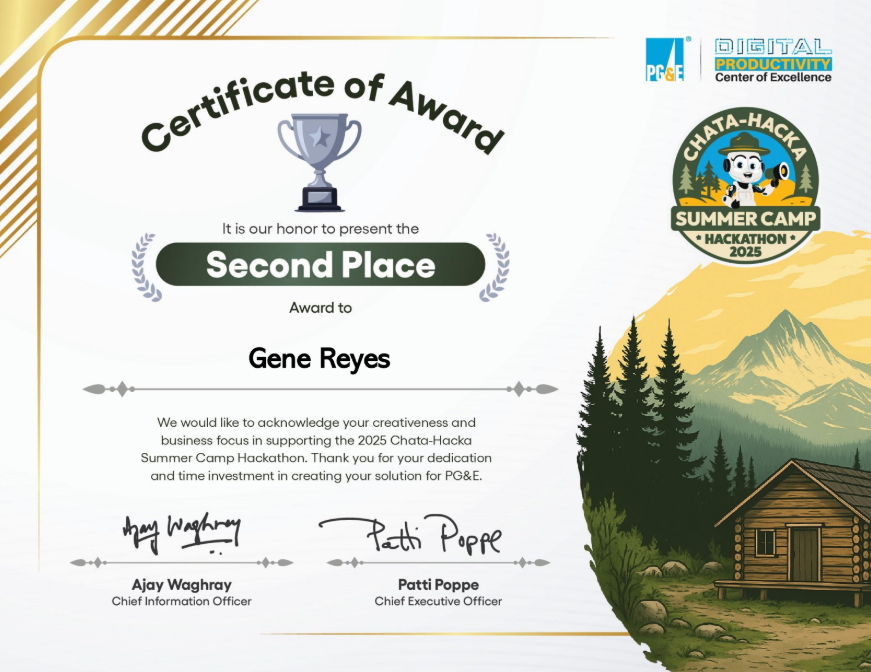
<p>I built a customer satisfaction agent: something that reads customer comments about our web experience, works out what’s going wrong, and routes it into a plan someone could act on. Microsoft Copilot, a few Power Automate workflows, and enough data processing to turn messy verbatims into something a business unit could use. It took second place.</p>

<div class="image-container">
  <a href="/assets/img/projects/hackathon/thumbnail.png" target="_blank">
    <img src="/assets/img/projects/hackathon/thumbnail.png" alt="Avatar" class="image" />
    <div class="overlay">
      <div class="text">
        
          View Demo &rarr;
        
      </div>
    </div>
  </a>
</div>

<p>The build wasn’t the interesting part. Plenty of the other 34 solutions were more sophisticated. What I had was a number I could defend: roughly 520 hours saved annually, under assumptions I’d stress-tested before anyone in the room could. That’s the same problem I keep running into in <a href="/about">most of the reporting work I’ve done</a>. Someone has a decision to make and no clean way to make it, and the tool matters less than whether the person looking at it can act.</p>

<p>The part that stuck with me happened between rounds. A judge gave me a specific note after the first pitch. I made finals not expecting to, and in the gap I went back and built the change. When I got in front of the second panel, I opened by telling them their predecessor’s feedback was already in the demo.</p>

<p>I don’t know how much that mattered to the score. But it’s the piece I’d repeat.</p>

<hr />

<p>Doing all of it alone was the other thing. No one to hand the deck to, no one to own the model while I owned the pitch. I wouldn’t recommend it, and second place still feels a little like first loser. Next time I’d bring a couple of all-stars instead of running the whole thing myself. But it made one thing obvious: the concept and the case for it took more of my time than the build did, and that ratio felt about right.</p>

<p>That’s the part I took with me. Not that the agent worked, plenty of things work, but that the hardest question all week was whether it should exist. I’ve been building smaller things since, mostly to keep asking that question in lower-stakes rooms. More to come.</p>]]></content><author><name>Paul Le</name></author><summary type="html"><![CDATA[I competed solo against teams at a 275-person internal AI hackathon and placed second — the technical build mattered less than the story I told about it and what I did with a judge's feedback.]]></summary></entry><entry><title type="html">Web Foundations Review</title><link href="/foundations" rel="alternate" type="text/html" title="Web Foundations Review" /><published>2025-04-01T00:00:00+00:00</published><updated>2025-04-01T00:00:00+00:00</updated><id>/foundations</id><content type="html" xml:base="/foundations"><![CDATA[<p>I took the first quarter of the year to re-learn as much web development as I could as part of my professional development plan. I don’t think I will be a web developer but I know that as long as I want my work to revolve around the web, I would need to keep brushing up on these fundamentals. This is not my first foray into web development. I have dabbled a lot with it during college. Exhibit A would have to be this site you’re reading this post on. Another example would have to be my <a href="https://www.genevereyes.com/projects/pikstop">last blog post</a>.</p>

<h4 id="content">Content</h4>
<ol>
  <li>Learning</li>
  <li>HTML/CSS</li>
  <li>JavaScript</li>
  <li>Other Technologies</li>
  <li>Summary</li>
</ol>

<h4 id="learning">Learning</h4>
<p>The main platform I used was <a href="https://www.theodinproject.com/">The Odin Project</a>. Fun fact: I had started on “TOP” just right around the time it started in 2014. It has since become one of the most popular learning platforms for web development.</p>

<p>For this round, I decided to brush up on the fundamentals of HTML, CSS, and JavaScript. I also refreshed my knowledge of GitHub and Linux. Learned new Command Line techniques and learned the basics of Visual Studio Code.</p>

<h4 id="htmlcss">HTML/CSS</h4>
<p>HTML and CSS are the two most important languages to learn for web development. There are many ways to get a site up and running without code but there’s still something to be said about hand-coding a page, no matter how simple. My biggest takeaway from this section was how to properly using CSS Flexbox. I don’t think this even existed when I first dabbled but it’s pretty fun to see just how far development has gotten. My favorite resource from this section was the inspiring work of <a href="https://www.joshwcomeau.com/css/interactive-guide-to-flexbox/#flex-basis-7">Josh W. Comeau</a>. His Flexbox guide is a must-read for anyone trying to understand it.</p>

<h4 id="javascript">JavaScript</h4>
<p>I’m not gonna lie, JavaScript gave me a little of bit of <a href="https://github.com/gnve/javascript-exercises">trouble</a>. If there is one complaint about TOP, some of the materials it expected me to use weren’t necessarily in the reading, but I also understand that such is the life of the web developer, not everything is entirely given to you if you want to do it the right way (Hello AI).</p>

<p>I also learned a lot about how to use the console to debug and test my code. I do a bit of this already for web analytics but it was super helpful to just brush up on the basics. My favorite resource for this section would undoubtedly be the entire <a href="https://developer.chrome.com/docs/devtools/">Chrome Dev Tools Site</a>. It opened my eyes up to how good a well-managed web product could look like. Not only was the resource super helpful, it was also <em>fun</em>.</p>

<h4 id="other-technologies">Other Technologies</h4>
<p>Like I said earlier, I learned a bit about GitHub and Linux in this section as well. I used an old Lenovo ThinkPad and installed Linux Mint to have dedicated machine for this project. That alone was another fun learning experience. I can also now confidently say that I can do some basic file management with the terminal now, whereas I only really knew <em>cd</em> before.</p>

<h4 id="summary">Summary</h4>
<p>Revisting some of these technologies was a fun side project. I don’t think I will proceed with learning the intricacies of backend development but I know I will run into them one way or another in my career. During this excercise though, I ran into AI agents such as <a href="https://lovable.dev/">Lovable</a> and <a href="https://bolt.new/">Bolt</a>. It’s so insane how much AI has come in just a few short years. AI Agents creating a full stack SaaS complete with authentication, database, and even payment processing in a few seconds is insanity.</p>

<p>That may be the next project I try to tackle.</p>]]></content><author><name>Paul Le</name></author><summary type="html"><![CDATA[I took the first quarter of the year to re-learn as much web development as I could as part of my professional development plan.]]></summary></entry></feed>